
Educational Goals
The ISE currently offers three programmes for children aged 3–18 and has developed a broad international curriculum. At both the international and Dutch Bilingual primary school, we use a thematic approach to learning. In the Dutch Bilingual department, we do this based on the Dutch national curriculum core objectives, which, starting this school year, we offer within the IB PYP Program of Inquiry.
Foundation Group
The ISE also has a Foundation group. This is a group that children from the age of 3 can attend for a number of half-day sessions per week. Here, they are offered activities in two languages in a playful manner. The Foundation group is located on the campus at Oirschotsedijk. The aim of the bilingual Foundation group is to ensure that children can develop in a safe and healthy environment and experience a smooth learning process. Education in this group focuses on preparing children for school. It provides them with a broad foundation of knowledge and skills, ensuring they are well-prepared for the future, both in school and in their later lives. After the Foundation group, children can transition to either the Dutch bilingual department or the International department. Children moving on to the Dutch bilingual department can start in group 1 at Jan Luikenstraat as soon as they turn 4.
Primary School
At the Dutch Bilingual Primary Department, children continue to develop from the moment they enter group 1 until they transition to secondary school at the end of group 8. Instead of separate subjects, we work with transdisciplinary themes (the PYP units), in which subjects like geography, history, and science are interwoven with language and mathematics. Through inquiry-based learning, children are challenged to ask questions and make connections themselves. In this way, they master the Dutch national curriculum core objectives, while simultaneously developing their English language proficiency and a broad, international mindset.
Personal Attention
The benefits of international education are multifaceted. Small class sizes, combined with a wide variety of cultures and nationalities, ensure that students feel at home quickly. We develop the unique talents of every child. We enrich the children with a multitude of cultures, without forgetting their own. We help children become global citizens who feel they can make a difference in their own future, as well as in the lives of others.
Schools work with a plan to improve the quality of their education. The plan helps them to continue providing education that satisfies everyone involved. The goals that all departments of the ISE are working on are described in detail in the school plan (School Development Plan). Our current school plan was established for the 2022–2026 period. In connection with the upcoming merger, our board has decided to work with an Addendum to the current school plan until 2028, and to draw up a new school plan only after the merger. Based on the 2026–2028 Addendum, annual goals have been set for each department.
The 2026–2028 Addendum includes the following priorities for the Dutch bilingual department:
- During the candidacy period (2026–2028), we will implement the IB PYP framework step by step. By the end of the 2027/2028 school year, we will have a fully continuous learning pathway (Program of Inquiry), all team members will be trained, and we will be working according to the inquiry-based methodology, ready for final authorization.
- Following the successful professional development of the team in the field of Dutch as a Second Language (NT2) and the implementation of ‘Wereld vol Woorden’ (World full of Words) within the DAL lessons (NT2 lessons), the next step is to structurally embed support for our non-native students into the new PYP framework. This will ensure a sustainable integration of language support into our curriculum.
- To increase the well-being of our students, social-emotional development (SEO) will be fully integrated into all Unit of Inquiry planners by the end of the 2027/2028 school year. Additionally, we will have implemented a new anti-bullying protocol specifically for our department, featuring a step-by-step plan that the entire team will use during incidents.
Reference Levels
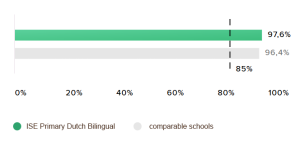
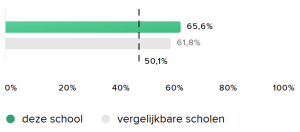
The Education Inspectorate checks whether the education at schools is of a sufficient level. The results of the standardized test in group 8 (doorstroomtoets) are important for the inspectorate. From August 1, 2020, the inspectorate uses reference levels to determine whether a school is performing sufficiently.
The standardized group 8 test measures the following for Dutch language and mathematics:
- What percentage of students achieved the basic level (this is also called the fundamental level).
- What percentage of students achieved the target level (this is a higher level that students can achieve).
The fundamental level (fundamenteel niveau) and the target level (streefniveau) indicate which level the students at the school have achieved in the areas of language and mathematics. To assess whether the school has scored sufficiently, they are compared with signalling values from the Education Inspectorate: The minimum percentage the school must achieve on both levels is determined in advance. These percentages are determined by the Education Inspectorate. If the school scores lower than this set minimum value, this can be a signal that something is not going well at the school. That is why these minimum scores are called ‘signal values’ (dotted lines in figures below). When the percentage of pupils at the school for both the fundamental level and the target level are at or above the signal values, the results in that school year are sufficient. We are proud that our results confirm that we offer our pupils high quality education and that we achieve these levels:
Fundamental Level
Target Level
Source: DUO